

JELIO ENGINEERING INSIGHTS
Guillotine PCB Depaneling: A Purchase Checklist
A guillotine PCB depaneling checklist should help procurement compare what will actually be supplied and accepted. The machine name alone does not describe board revisions, blade access, air connections, handling arrangements or evidence required before shipment. For the JELIO JLO-C320, start with the published pneumatic guillotine specifications and connect each relevant row to a purchasing question. This guide separates catalog screening from representative sample review and a written quotation. It is intended for buyers coordinating engineering, quality and production input, so the purchase record names the intended configuration and assigns responsibility for remaining checks before the order is released.
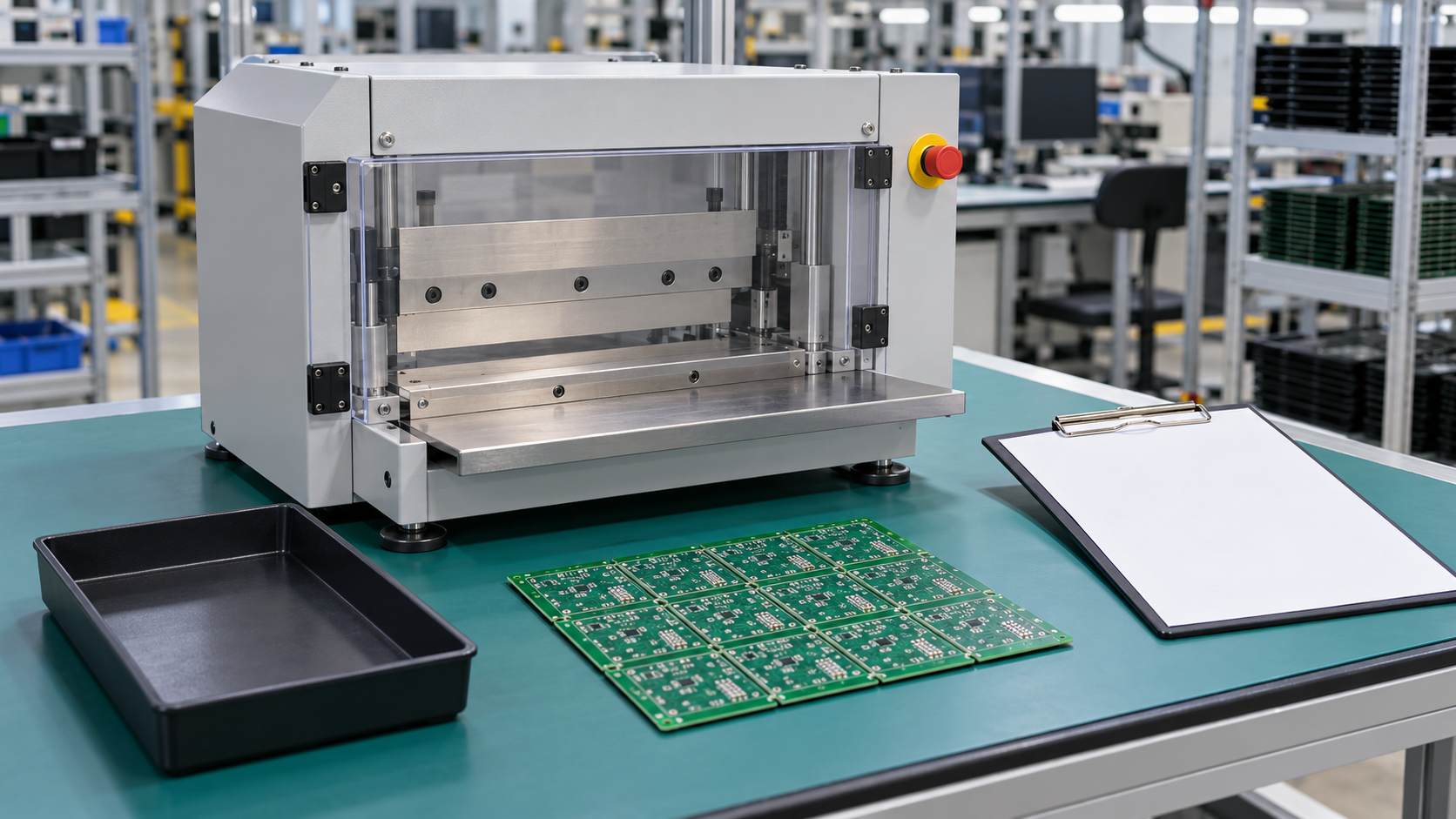
What should a guillotine depaneling purchase checklist cover?
Identify board revisions and materials, compare the selected model’s envelope and component clearance, and review utilities and handling with production. Request a quotation naming the configuration, documents and service scope. Agree representative sample checks and acceptance responsibilities before order release. Keep catalog cutting-rate statements separate from the complete production cycle demonstrated with your board.
1. Make the purchase request describe the workpiece
Attach a controlled board list to the enquiry. For each family record drawing and assembly revisions, material, thickness, separation length and populated-board envelope. Identify the representative sample provided for application review. If the equipment will serve several families, explain what each sample represents rather than assuming a convenient demonstration board covers the complete production mix.
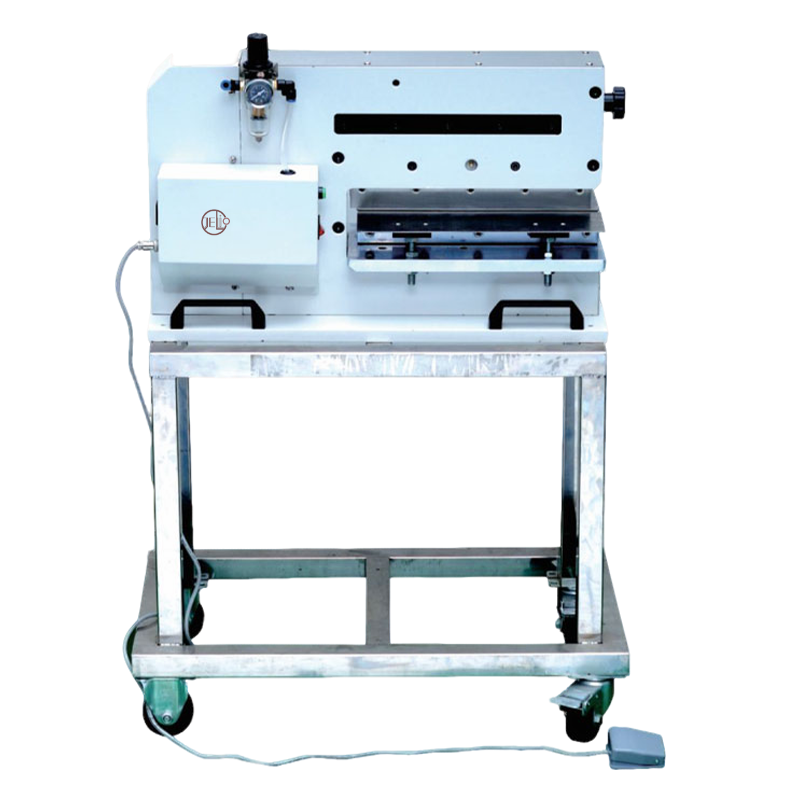
The JLO-C320 page describes a pneumatic guillotine for V-cut boards with dual straight blades and foot-pedal control. Its material description includes fiberglass, aluminum and copper substrates within the stated thickness range. Preserve that model-specific scope when preparing the enquiry. The workpiece record connects the published offering to your purchasing task without replacing the existing catalog facts.
Ask engineering to flag connector overhangs, interrupted scores and boards requiring a different orientation. Procurement does not need to invent a cutting method. It needs a clear supplier response and an owner for every unresolved fit question. Keep responses beside the board list so the team approving the purchase and the team receiving the machine use the same basis.
2. Convert catalog screening into engineering questions
The parameter table below reads directly from the JLO-C320 product record. Length, thickness, voltage and working air pressure provide initial screening information. Component height is directional in the source, distinguishing upward and downward depaneling. A purchasing spreadsheet with one maximum height would omit information needed to review the actual board orientation and working access.
The component-to-groove distance row includes a customizable qualification. If the proposal depends on a change, request the affected feature and application-review basis in writing. Customization availability is not an approved clearance for every assembly. Keep drawing, response and configuration together so a later board revision can be assessed against the same basis.
Review machine and movable-workbench dimensions with production’s layout. Confirm how boards will be received, located and collected. Ask the site team to check proposed electrical and air connections against the supplied requirements. Installation follows approved documentation and qualified site review. The purchasing checklist assigns responsibility for that work instead of substituting a catalog value for an installation procedure.
3. Compare written inclusions and responsibility
Use the same headings across proposals: named equipment, covered boards, supplied support, application changes, documents, training, parts and acceptance deliverables. Mark each as included, separately quoted or awaiting clarification. Unanswered items must remain visible rather than becoming assumed standard inclusions when a proposal is shortened for approval or copied into an order summary.
Compare configuration against configuration. If support or an application-specific change is required, record the workpiece feature that makes it necessary. Retain the engineering explanation and the commercial inclusion together. An order can name the right base model while omitting the very feature on which a successful sample review depended.
Start the service discussion with JELIO after-sales support, then request applicable written scope. Identify the contact route, documentation to retain and information required for parts identification. Delivery, price, training and warranty arrangements should come from the actual quotation or service document. This checklist provides comparison fields; it does not create new commercial commitments.
4. Define acceptance with representative samples
Agree sample identities, inspection locations and criteria with engineering and quality before the demonstration. Request records connecting board revision, supplied configuration, cutting sequence and returned samples. Include the populated features that drove clearance questions. A bare-board demonstration may introduce the process, while the purchase record should identify the evidence required for the intended assembly.
Use the product’s requirements to define checks: separated edge, specified dimensions, sensitive nearby features and any functional or reliability inspection required by the buyer’s quality plan. Identify who performs each check and closes exceptions. The sample-test checklist helps organize the agreement without creating a universal pass limit or implying unperformed tests passed.
The cab MAESTRO 4S, 4X and MAESTRO 6 manual illustrate material, access and notch-related configuration questions. Their features and settings belong to those machines. For the JLO-C320, retain its own documentation and the supplier response addressing your workpiece.

5. Separate a cutting rate from the complete cycle
The JLO-C320 table states one cut per second as its depaneling speed. Keep that published statement attached to the cutting operation. A capacity review also includes presenting the panel, locating it, performing all required cuts, changing orientation where necessary and collecting pieces. Do not convert the cutting-rate row into an hourly production guarantee without defining the remaining sequence.
For a timing study, record whether the panel was assembled, how many cuts it required, the handling arrangement and which pauses were included. Identify dependencies on another workstation or operator action. Timing evidence is useful when the production team can recognize the conditions and compare them with its intended process rather than guessing what a short video left out.
Before order release, close a responsibility register listing the approved configuration, covered boards, retained evidence, open actions and responsible company functions. Request the configuration quotation with that register. Preserve it for receiving and commissioning, so acceptance follows the scope approved by procurement instead of a shorter checklist reconstructed after the machine arrives.
Three records, three purchasing decisions
Review envelope, utilities and clearance.
Name inclusions and agreed changes.
Identify samples and required checks.
Base-model enquiry versus application-scoped request
| Item | Base-model enquiry | Application-scoped request |
|---|---|---|
| Boards | Model name | Revisions and representative samples |
| Clearance | One height | Directional limits and orientation |
| Utilities | Factory supply | Written voltage and air review |
| Changes | Assumed availability | Named feature and supplier response |
| Rate | Cutting only | Complete cycle and boundaries |
| Acceptance | Demo video | Samples, checks and responsibilities |
Published specifications for the application review
JLO-C320: source catalog values for this product family.
| Parameter | Published value |
|---|---|
| Model | JLO-C320 |
| Machine Dimensions | 680x250x450MM |
| Movable Workbench Dimensions | 720x420x750MM |
| Working Voltage | 220V |
| Working Air Pressure | 0.4-0.6Mpa |
| Depaneling Length | 0-300MM |
| Depaneling Thickness | 1.0-3.0MM |
| Depaneling Speed | 1 cut per second |
| Component Height Limit | Component height ≤ 40 mm for upward depaneling; ≤ 15 mm for downward depaneling |
| Distance from Component to V-cut Groove | ≥3MM (customizable) |
Guillotine purchasing review
- 01
Define
Identify covered board families.
- 02
Screen
Review fit, clearance and utilities.
- 03
Confirm
Record quotation inclusions.
- 04
Review
Close sample evidence and actions.
- 05
Release
Assign acceptance responsibilities.
Frequently asked questions
Does one cut per second guarantee hourly output?
It is a cutting-rate statement. The complete cycle also includes loading, location, all cuts and collection. Request representative timing evidence with boundaries defined before capacity planning.
What belongs in the enquiry package?
Send drawing and assembly revisions, material, thickness, separation lines, component envelope and representative sample list. Add handling requirements and questions needing a supplier response.
How should customization be compared?
Name the proposed feature, the workpiece it addresses and review evidence. Confirm its quotation inclusion and retain the agreed configuration with the request.
Can company certificates replace machine acceptance?
They serve different scopes. Qualifications and R&D records support supplier evaluation. Acceptance evidence identifies the selected configuration, workpieces, checks and agreed disposition for the purchase.
Who approves the final checklist?
Assign engineering to fit and configuration, quality to evidence and criteria, production to utilities and handling, and procurement to commercial scope. Record the responsible company functions.
Related equipment and guides
Request a JLO-C320 configuration quotation
Share your board list, assembly drawings and acceptance questions to review the proposed supply scope.
Request a JLO-C320 configuration quotation →