
 WhatsApp: +8615306204105
 Email: xuhejian@jelio.com.cn
JELIO ENGINEERING INSIGHTS
PCB Depaneling Sample Test: Acceptance Checklist
A PCB depaneling sample test should answer whether a proposed machine configuration can separate your actual panel to the agreed drawing, edge-quality and handling requirements. A short cutting video helps, but a purchase decision also needs a repeatable inspection record and a definition of the complete production cycle. This checklist is for EMS process engineers, quality engineers and equipment buyers preparing a trial before an RFQ or factory acceptance review. It connects the information you send with the evidence you should receive, using JELIO’s published sample-testing service and catalog specifications as the starting point.
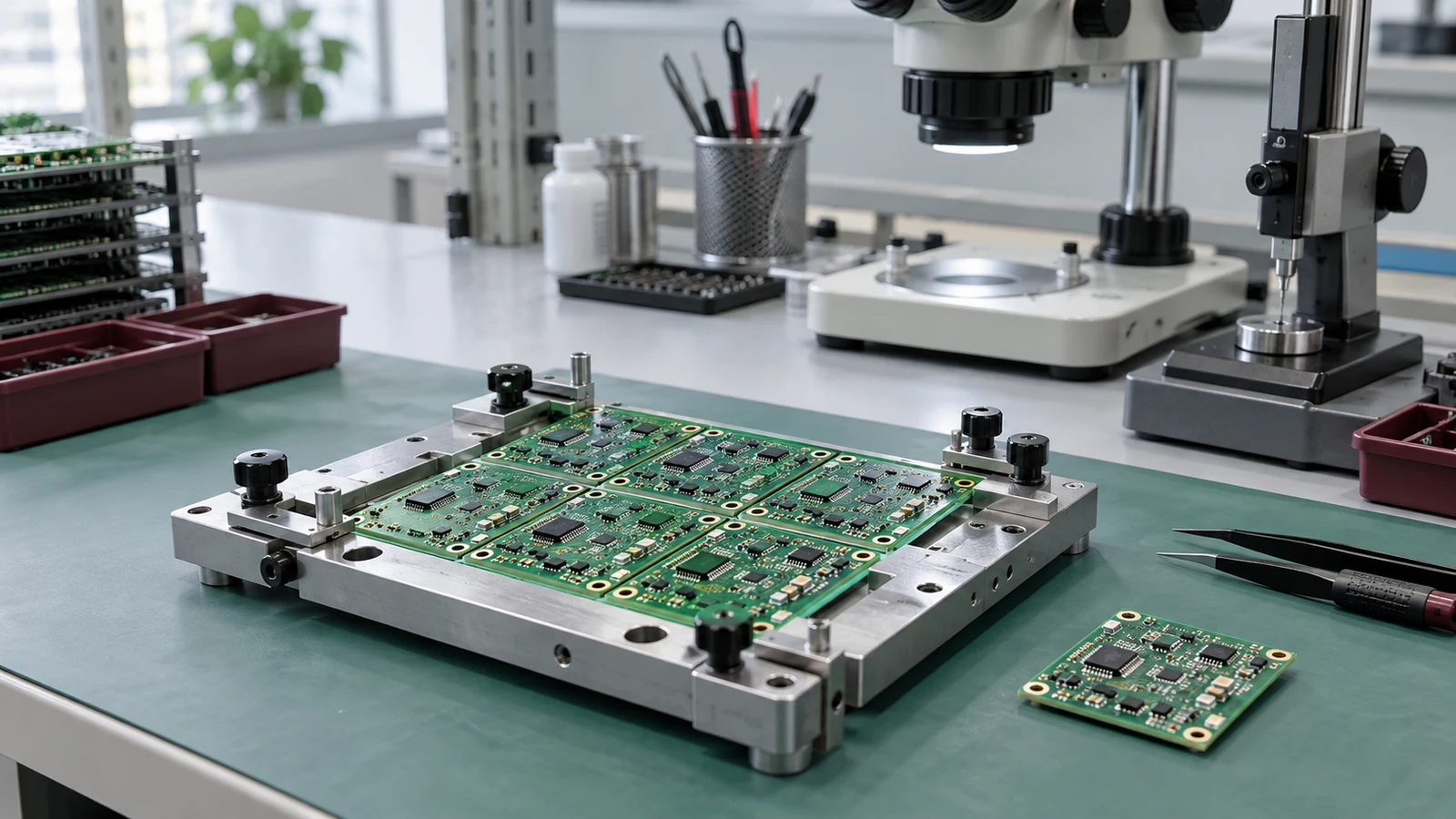
What should a PCB depaneling sample test include?
Include the released panel drawing, populated sample boards, component-clearance information and written acceptance criteria. Record the machine configuration, fixture, tool, program revision and inspection method. Evaluate the routed edge, drawing dimensions, board support, dust handling and the complete load-to-unload cycle. Ask for photographs, dimensional records and process video linked to the same sample identification.
1. Prepare a trial package that represents production
Start with one controlled panel revision. Identify the individual board outline, tabs or bridges to remove, tooling holes, fiducials and the datum from which the finished outline will be inspected. Include top and bottom component drawings with the heights and keep-out areas that matter to the cutter, fixture and board transfer. A bare PCB may be useful for initial programming, but it does not represent every constraint of a populated assembly.
Tell the supplier which panel conditions vary in normal production: board thickness, supported variants, panel orientation and the condition in which boards arrive at depaneling. Describe those differences explicitly rather than asking a single ideal sample to represent the whole product family. Label each sample and reserve matching boards for your own comparison after the trial. Decide how samples and drawings will be exchanged through the agreed contact channel.
JELIO’s technical-support page lists free trial cutting, complete-process video, microscope edge images, dimensional verification and a machine recommendation report. Use those deliverables as the basis of the request. For a broader equipment shortlist, review the product catalog before specifying which process should be evaluated.
| Input | Information to provide | Why it matters |
|---|---|---|
| Drawing revision | Released outline, panel layout, datum and tolerances | Keeps programming and inspection on the same revision |
| Assembly layout | Top/bottom component positions and heights | Supports fixture and cutter-clearance review |
| Sample identity | Board revision, panel ID and variant | Connects images, measurements and video |
| Quality criteria | Inspection locations, method and drawing limits | Defines the decision before the trial |
| Handling brief | Infeed orientation, outfeed/tray and required cycle definition | Tests the handoff as well as the cutting path |
2. Agree what a passing result will look like
Separate drawing conformance, edge appearance and handling into distinct checks. For dimensions, name each characteristic and its datum; record the nominal value and the tolerance from your released drawing. For edge review, identify locations such as tab remnants, corners and regions near sensitive components. Define how photographs will be taken so an overview and a close-up refer to the same board and inspection position.
A useful record has a row for each inspected feature, not just an overall statement that the board looks good. Include sample identification, the actual observed value or observation, the instrument or inspection method, the acceptance criterion and the reviewer’s disposition. When a feature needs additional investigation, record the corrective action and retain the before-and-after evidence under separate trial revisions.
Do not turn an equipment catalog limit into a measured sample result. The JLO-C3532 / JLO-C5045 product page lists Cutting Accuracy and Repeatability separately. Your acceptance record should state which finished-board characteristic was measured and how. The companion guide on cutting accuracy versus repeatability explains how to keep those questions separate.
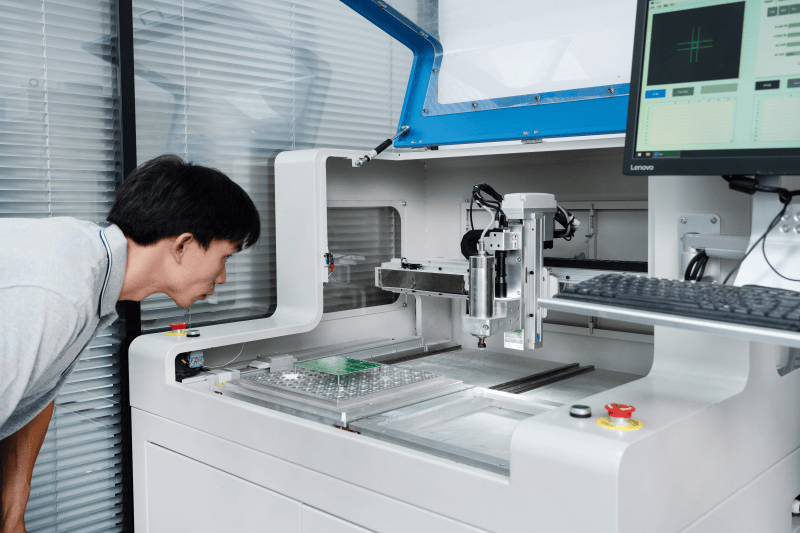
3. Freeze the configuration before comparing suppliers
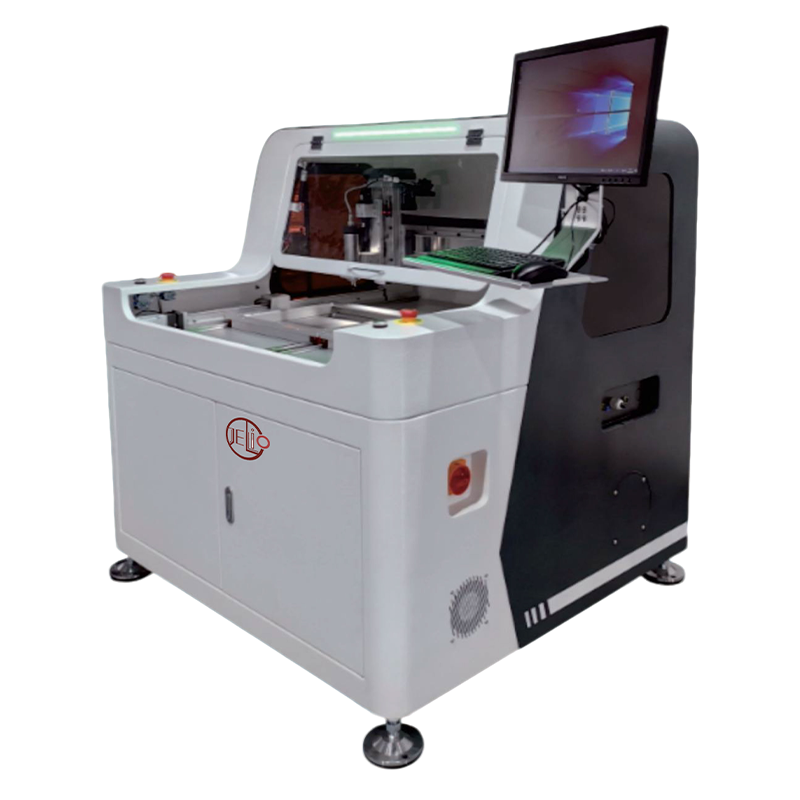
Record the proposed model, workholding approach, tool identification, program revision and camera-compensation setup. For the JLO-C3532 / JLO-C5045 family, the catalog identifies manual tool change with automatic tool change optional. The same page lists bottom full suction with other extraction arrangements optional. A quotation and trial record should describe the selected configuration rather than treating every catalog option as installed equipment.
The parameter table below is a screening reference taken directly from that product page. Its panel sizes are per single station, with each value paired to its corresponding model. Check your panel against that envelope before arranging a trial; also review component height and the supported cutting-tool range. Being inside these published limits is a reason to discuss a sample, not a substitute for the sample assessment.
If the trial requires a fixture change, a revised toolpath or a different extraction arrangement, issue a new configuration record. Buyers can then compare the quoted machine with the configuration that produced the sample evidence. This is also the point to ask customization support about an application requirement that changes the standard scope.
4. Observe the complete cycle and the finished board
Define the timing boundary before starting the recording. A repeatable boundary could be from a panel arriving at the agreed loading position to separated boards reaching the agreed output location. Write down that definition. Identify which activities can overlap and record the actual sequence, including loading, positioning, cutting, unloading and any necessary operator action.
Keep cutting-path time and complete-cycle time in different fields. Record interruptions and the conditions that caused them rather than removing them without explanation. If you need evidence for a production takt requirement, agree a representative sequence and number of runs with the supplier and your quality team. This guide deliberately supplies no universal sample count or cycle target; those belong to the actual application.
At the output, inspect how the boards are supported and transferred. Confirm the intended receiving tray or process handoff with the same board orientation used in the trial. Retain the original process video alongside the inspection record so a reviewer can connect a handling observation with the corresponding sample and configuration.
5. Use current industry practice to ask better questions
Global depaneling manufacturers increasingly explain equipment selection together with handling and inspection. The ASYS milling and sawing overview presents these as related configuration decisions. That is a useful buying perspective: a trial should cover the route into and out of cutting, not just the separated outline.
The 2026 industry review also found an LPKF Depaneling Day agenda scheduled for 24 June that included fixtures and customer-sample demonstrations. The agenda supports the relevance of application-led trials; it is not a source for JELIO machine capabilities. For your project, keep the discussion anchored to your sample and the selected JELIO product page.
6. Carry the evidence into the RFQ and acceptance review
Attach the approved drawing revision, sample IDs, configuration list and trial conclusions to the RFQ. Identify who owns the fixture, who approves the inspection method and which output handling items are included in the proposal. Ask for the supplied documentation, training and service scope to be written into the quotation rather than estimating them from a demonstration.
Keep the sample-trial acceptance and the eventual factory or site acceptance as separate project milestones. They can share inspection definitions, but the delivered configuration and production environment also need to be recorded. A clear handover lets process engineering, quality and purchasing review the same evidence without promising a result that has not yet been measured.
Use the comparison and workflow below to prepare the review meeting. The output should be a short list of accepted conditions, open actions and the evidence needed to close each action. This creates a practical path from a promising cut sample to an equipment proposal your team can assess.
Three evidence layers for a purchasing decision
What must be cut
What was evaluated
What the team accepts
A demonstration clip vs. an acceptance-ready trial
| Decision | Demonstration clip alone | Acceptance-ready trial record |
|---|---|---|
| Panel identity | Board is visible | Sample ID and drawing revision accompany the footage |
| Cut quality | Visual impression | Named edge locations and an agreed inspection method |
| Dimensions | Appearance of the outline | Recorded characteristics, datum, drawing limits and results |
| Timing | Selected cutting sequence | Written timing boundary and complete handling sequence |
| Purchase scope | Machine appears in operation | Model, fixture, tool, options and proposal scope are linked |
Published specifications for the application review
JLO-C3532/JLO-C5045: source catalog values for this product family.
| Parameter | Published value |
|---|---|
| Model | JLO-C3532/JLO-C5045 |
| Number of Workstations | Dual Station |
| Max. PCB Depaneling Size | 350mm(X)*320mm(Y)(Single Station)/500mm(X)*450mm(Y)(Single Station) |
| PCBA Component Height | Upper:15mm Lower:45mm |
| Cuttable PCBA Thickness | 0.5~4mm |
| Spindle Tool Range | φ0.5~3mm |
| Cutting Accuracy | ±0.05mm |
| Repeatability | ±0.02mm |
From sample request to a documented decision
- 01
Define
Release drawing, sample IDs and acceptance criteria.
- 02
Configure
Agree model, fixture, tool and selected options.
- 03
Trial
Record the complete handling and cutting sequence.
- 04
Inspect
Attach dimensions, edge images and dispositions.
- 05
Review
Carry accepted conditions and open actions into the RFQ.
Frequently asked questions
Is sample cutting available before purchasing a JELIO machine?
Yes. JELIO’s technical-support page lists free trial cutting, complete-process video, microscope edge analysis, dimensional verification and a machine recommendation report. Contact the team to arrange the application review and sample exchange.
Should I send a bare PCB or a populated PCBA?
Include the assembly information and representative populated panels when component clearance, support or handling matters. Agree the sample mix with the engineering team; a bare-board programming check and a populated-board trial answer different questions.
Can the catalog cutting accuracy be used as my sample result?
Use the catalog value for the stated model and parameter. A sample result needs its own identified feature, datum, inspection method, drawing limit and recorded observation. Keep those records separate.
How should I compare cycle times from different proposals?
Use the same start and finish boundary, panel revision and handling scope. Keep cutting-path time separate from complete-cycle time and retain the sequence record so the difference is reviewable.
What should I send to request a technical quotation?
Prepare the panel drawing, assembly layout, sample IDs, acceptance criteria, intended input/output arrangement and required configuration. Include the trial conclusions and any open actions so the quotation addresses the same scope.
Related equipment and guides
Request a sample-cutting review
Bring the panel drawing, assembly layout and acceptance checklist to the JELIO engineering team.
Request a sample-cutting review →


