
 WhatsApp: +8615306204105
 Email: 516947921@qq.com
JELIO ENGINEERING INSIGHTS
Integrated Depaneling: Comparing Station and Panel Envelopes
Integrated PCB depaneling specifications are easier to compare when each number has a named purpose. A station limit screens the incoming panel; axis travel describes motion; component heights qualify occupied space around the board. Procurement needs all three and a documented installation envelope before comparing quotations. This guide uses the JELIO inline integrated listing and its related paired model listing to show how to keep values attached to the quoted configuration and how to convert open questions into requests for drawings or sample evidence.
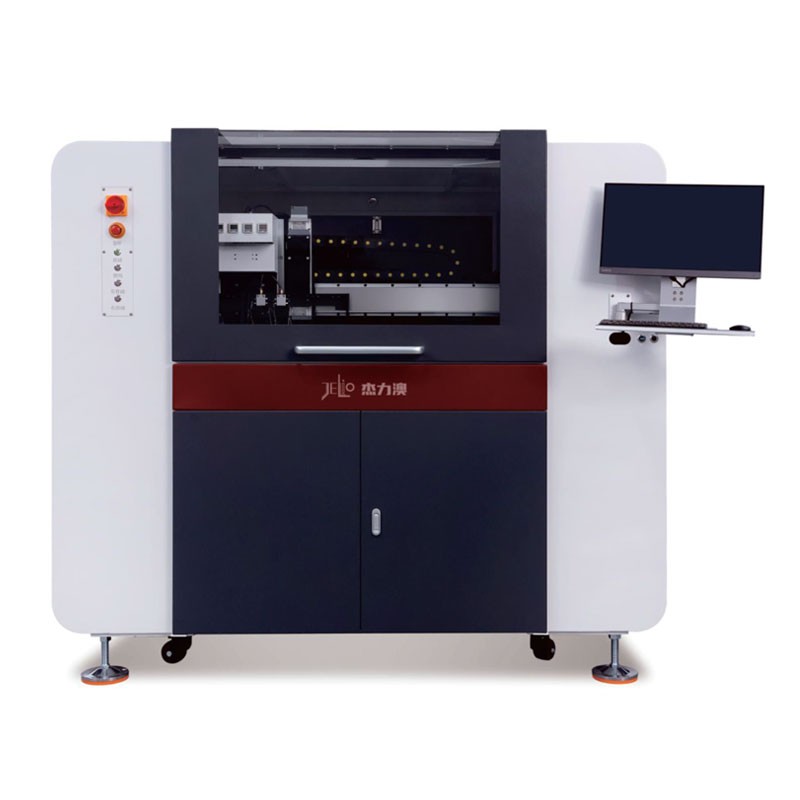
How should buyers compare integrated depaneling envelopes?
Compare the quoted single-station panel limit, the tool-specific occupied space and the installation layout separately. Keep the model and catalog configuration beside every value. Ask for a dimensioned fixture overlay and record pending questions before approving the quotation. Use axis travel for motion review, not as a substitute for panel capacity.
Separate panel size from machine travel
Procurement should ask vendors to mark the usable panel outline for the specific model and station they are quoting. The incoming panel includes rails and tooling features. It is not just the outline of a single finished board. State the orientation used to assign the drawing axes. If the answer depends on rotating the panel, request an updated layout showing locating features, components and the load direction in that orientation.
The JELIO inline integrated catalog gives the JLO-CXJ3235 maximum PCB depaneling size as 320 mm by 350 mm for a single station. Its listed machine travel describes axis movement, not the maximum PCB size. Dual stations do not make the listed single-station envelope twice as large. When a vendor proposes a different load arrangement, ask for its usable fixture drawing rather than adding the station dimensions or substituting travel figures.
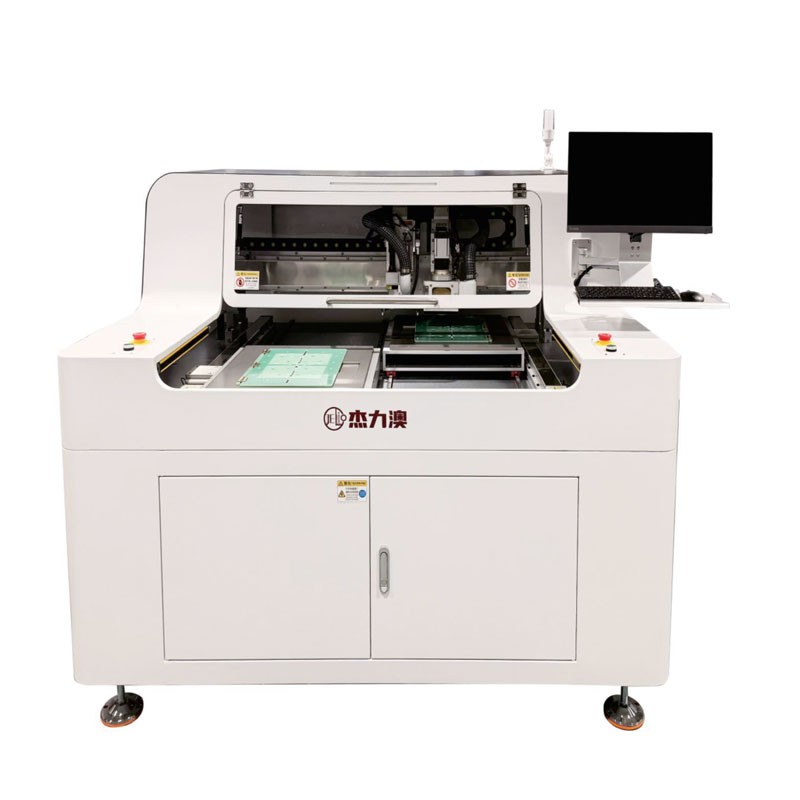
Keep model and configuration together
Compare the inline catalog against the integrated router and saw catalog, which lists the JLO-CXJ3235 and JLO-CXJ4550 in paired order. The paired row assigns 320 mm by 350 mm per station to the first and 450 mm by 500 mm per station to the second. Keep that pair attached to the specific listing. A model name appearing on two pages does not make the surrounding options, tool settings or installation requirements interchangeable.
The component height statements are especially important when a quote covers both methods. The inline page distinguishes milling and saw upper height figures and separately lists the lower figure. The paired listing states an upper and lower figure without that same mode breakdown. Put each statement in its own quote column. Ask the supplier which catalog configuration the offer follows and how the assembly fits with the chosen tooling. Do not resolve different scopes by copying the larger number into every column.
Review the complete occupied space
Request a drawing overlay showing both faces of the assembled panel, the fixture and the features used to load and remove it. Separate component height above the board from features below it. Include protrusions at the edge, since a connector can be a handling obstruction even if its body does not cross the intended cut line. Draw the retained rails and show whether the quoted fixture contacts them. Record restrictions by tool and operation when the same panel will be milled and sawn.
On the shop layout, show the machine footprint, opening and maintenance access and the space occupied by adjacent equipment. The cabinet dimensions in the catalog are useful for screening; they do not establish the complete space a line needs. Request a layout that distinguishes included equipment from customer-supplied items. If handling requires an interface between machines, have the line owner review its location and direction before procurement treats the layout as accepted.
Ask each bidder for the same evidence
A useful comparison sheet has a field for the quoted model, a field for the panel revision and a field for the evidence that closes each requirement. Split panel fit, component clearance and installation fit into separate decisions. A vendor may document one successfully and still need to review the others. Ask that exclusions and optional features be written beside the affected row rather than left in general quotation notes.
Keep published capabilities separate from sample results. A nominal cutting accuracy is a catalog statement, not the dimensional report for your panel. Where the project requires an acceptance test, identify the sample revision, the measurement points and the evidence to be returned. If the quotation covers a product family, define which geometry or assembly feature makes each selected sample representative. An approved small sample need not settle the layout of a larger variant.

Close the gaps before purchase release
Mark each comparison row as documented, pending drawing review or excluded from the quote. Do not score a pending row as a failure or an approval: assign it an owner and a concrete next action. For a tooling-access question, ask the process engineer for an operation drawing. For an installation question, ask the line owner to confirm the layout. For a sample question, specify the inspected edge, the drawing requirement and the record procurement must receive.
Carry the agreed scope into the purchase review with the station configuration, fixture, methods, service space and acceptance evidence named explicitly. Keep the full return drawing with the quotation so the next revision can be checked against the same assumptions. If a later panel variant changes the occupied space or loading orientation, reopen the affected comparison rows before extending the approval.
Example: a rotated panel on a larger station
Suppose one offer appears to fit a panel only when its axes are swapped. Ask the bidder to mark the load edge, fixture datums and the orientation at unloading on one drawing. An outline rotated in a spreadsheet says nothing about whether the existing carrier can locate the assembly that way. If a different carrier is needed, list it as a quoted item and link its drawing to the same revision as the panel.
If the panel fits the station but a tall component restricts a straight saw path, keep the panel fit row documented and the saw operation row pending. The mixed toolpath guide explains how to request a cut-by-cut review without turning a dimensional screen into process approval.
Three different envelopes
Dimensioned fixture overlay
Motion review for quoted configuration
Both faces with fixture and tooling
Envelope evidence by purchase decision
| Category | Meaning | Evidence |
|---|---|---|
| Panel size | Incoming panel in one station | Dimensioned fixture overlay |
| Axis travel | Machine movement | Motion review for quoted configuration |
| Component height | Occupied space by method | Both faces with fixture and tooling |
| Installation fit | Cabinet and access | Approved shop layout |
Published specifications for the application review
JLO-CXJ3235: source catalog values for this product family.
| Parameter | Published value |
|---|---|
| Model | JLO-CXJ3235 |
| Number of Workstations | Dual Station |
| Max. PCB Depaneling Size | 320mm(X)*350mm(Y) (Single Station) |
| Machine Travel | 950mm(X)*700mm(Y)*100mm(Z) |
| PCBA Component Height | Milling/Saw: Upper:15mm/10mm Lower:45mm |
| Cuttable PCBA Thickness | 0.5~4mm |
| Machine Dimensions | 2200mm(L)*1400mm(W)*1800mm(H) |
| Main Unit Power Specification | AC220V 50HZ 5.2KW |
Catalog screen to purchase review
- 01
Screen
Match the panel to the station.
- 02
Overlay
Review both assembly faces.
- 03
Compare
Document the quoted options.
- 04
Close
Assign and resolve open rows.
Frequently asked questions
Can I add the two station sizes?
No. The inline catalog identifies its maximum PCB depaneling size as a single-station value.
Does machine travel establish panel fit?
No. Screen against the published panel limit and use the proposed fixture drawing to review actual fit.
Why keep two JLO-CXJ3235 catalog rows?
The two listings have distinct configuration and clearance wording. Confirm the offer against the listing that applies.
Do cabinet dimensions include all service space?
Use the catalog dimensions for screening and request the installation layout for access and adjacent equipment.
How should I compare a pending fit question?
Record it as pending with an owner and a specific drawing or trial needed to close it.
Related equipment and guides
Request a configuration comparison
Send the panel drawing, expected orientation and quote scope for technical review.
Request a configuration comparison →


